Показаны сообщения с ярлыком English. Показать все сообщения

8 авг. 2011 г.

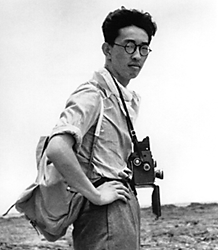
Yosuke Yamahata Photographing the Bomb, A Memo (1952)


Seven years have passed since the end of the war, and I am deeply moved to have the opportunity to present this archive to the public, and to recall the occasion on which I took these photographs. 

Many articles have been published, both from the point of view of experts and that of victims, about the military capabilities of the bomb and the tragic damage it inflicted. I don't consider it my place to speak about those issues. Rather, I feel it is my duty to allow viewers to judge with absolute freedom the data so starkly recorded by the camera. 

It may be useful in contemplating this archive to know the reason I took these photographs and the thoughts I had in mind as I took them, so I shall describe these facts along with the circumstances of the time as accurately as I remember. 

31 июл. 2011 г.

Atomic Bombing of Nagasaki - BBC

Atomic Bombing of Hiroshima - BBC

They say "Scientific Gamble"

The Medical Effects of the Nagasaki Atomic Bombing

An atomic bomb exploded over the Urakami district of Nagasaki at 11:02 a. m., August 9, 1945.A half a century has passed since that second nuclear calamity in human history, but the end of the nuclear age remains stubbornly out of sight. On the occasion of the 65th anniversary of the atomic bombing, the Scientific Data Center for the Atomic Bomb Disaster reorganized the information on the medical effects of the atomic bombing-particularly the late effects of exposure to radiation-assiduously compiled by researchers since the restoration of the former Nagasaki Medical College. The information presented here was chosen to give visitors a brief but comprehensive introduction into the effects of nuclear weapons.
 We hope that you will grasp the impact of the atomic bomb on the human body and that you will join us in striving to ensure that Nagasaki is the last place on earth to suffer the effects of a nuclear explosion.

>>> Further details

22 июл. 2011 г.

The lies of Hiroshima live on, props in the war crimes of the 20th century


The 1945 attack was murder on an epic scale. In its victims' names, we must not allow a nuclear repeat in the Middle East

When I first went to Hiroshima in 1967, the shadow on the steps was still there. It was an almost perfect impression of a human being at ease: legs splayed, back bent, one hand by her side as she sat waiting for a bank to open. At a quarter past eight on the morning of August 6, 1945, she and her silhouette were burned into the granite. I stared at the shadow for an hour or more, then walked down to the river and met a man called Yukio, whose chest was still etched with the pattern of the shirt he was wearing when the atomic bomb was dropped.

He and his family still lived in a shack thrown up in the dust of an atomic desert. He described a huge flash over the city, "a bluish light, something like an electrical short", after which wind blew like a tornado and black rain fell. "I was thrown on the ground and noticed only the stalks of my flowers were left. Everything was still and quiet, and when I got up, there were people naked, not saying anything. Some of them had no skin or hair. I was certain I was dead." Nine years later, when I returned to look for him, he was dead from leukaemia. 

Survivors Voice - Global Network

The National Peace Memorial Halls for the Atomic Bomb Victims Hiroshima and Nagasaki

Дальше »

Atomic Bomb Survivors - Nagasaki

Narratives of A-bomb Experience

Some atomic-bomb survivors are active as "kataribe," storytellers who recount their personal atomic bomb experiences to younger generations, in the strong hope that there will never again be A-bomb victims, and that all nuclear weapons will be eliminated from the Earth. However, as the A-bomb survivors age, each year we have fewer opportunities to hear their stories. This section introduces the stories of three A-bomb survivors who still continue their activities as kataribe. We hope that these stories will help readers realize what happened on the day Nagasaki was A-bombed, and will encourage them to think about what is important for our future.

Дальше »

10 июл. 2011 г.

Incidence of intracranial meningiomas in Nagasaki atomic-bomb survivors


Abstract

Among the Nagasaki atomic-bomb survivors registered at the Scientific Data Center for Atomic-Bomb Disaster, Nagasaki University School of Medicine, 45 cases of surgically treated intracranial meningioma were collected from 6 hospitals with departments of neurosurgery in or near Nagasaki City during the period from 1973 to 1992. All 45 patients were over 40 years of age at the time of diagnosis. Subsequently, the 45 cases were statistically analyzed in relationship to the estimated distance from the hypocenter by age, gender, intracranial location, histology and latent period. The analysis showed a high correlation between incidence of meningiomas and distance from the hypocenter. The incidence among Nagasaki atomic-bomb survivors over 40 years of age, especially in those proximally exposed, appears to be increasing, in inverse proportion to the exposure distance, since 1981, 36 years after the explosion of the atomic bomb. © 1996 Wiley-Liss, Inc.

9 июл. 2011 г.

Damage Caused by Fire


Damage Caused by the Fire

The damages caused by the flash of heat and blast were aggravated by subsequent fires. These leveled neighborhoods where the blast had inflicted only partial damage. In total, 12,900 houses were completely burned or destroyed and another 5,509 were partially burned or destroyed. The fire also increased the number of victims. Many people trapped under fallen debris had suffered only external injuries but died as the fires raged through the city.

The gutted ruins of the Iwakawa-machi neighborhood
About 800 meters south of the hypocenter. The lush roadside trees in this quiet residential neighborhood burned to ashes. The explosion had completely buried the road in rubble.
(Photograph by Torahiko Ogawa)

The devastation near Nagasaki Medical College
About 600 meters east-southeast of the hypocenter. Except for a few reinforced-concrete structures, the buildings to the upper left were completely destroyed and burned. The building to the lower right is the Nagasaki Medical College Hospital.
(U.S. Army Institute of Pathology Photographs)

-Quote from Nagasaki Atomic
 Bomb Museum

Nagasaki - Atomic Wasteland


Nagasaki, the Atomic Wasteland

Caused by the Bomb Nagasaki City on August 9,1945
Population : about 240,000
Deaths and injuries caused by the atomic bomb
(estimates up to the end of December 1945)
- Deaths : 73,884
- Injuries : 74,909
(from a 1950 study by the Committee for the Preservation of Atomic Bomb Artifacts)

The area in front of Nagasaki Railroad Station
About 2.4 kilometers south-southeast.
(Photograhy by Torahiko Ogawa)

Wall clock
Found in a house near Sanno Shinto Shrine in Sakamoto-machi, about one kilometer from the hypocenter. The clock was shattered by the blast, and its hands stopped at 11:02-the moment of the explosion.

Water tank from Keiho Middle School
Water tank with contorted legs from Keiho Middle School, site of present-day Nagasaki Nishi High School.


- Quote from Nagasaki Atomic Bomb Museum

Dr. Takashi Nagai


The Achievements of Dr. Takashi Nagai

Takashi Nagai, an assistant professor at the Nagasaki Medical College, was exposed to the atomic bomb explosion in the college hospital. In spite of his own serious injury, he immediately began selfless efforts to assist the victims and to launch studies concerning atomic bomb disease. His efforts later shifted from medical concerns to the restoration of the city and culture of Nagasaki and to the realization of world peace. Dr. Nagai had been suffering from leukemia from before the atomic bombing, but even when his condition deteriorated he continued his research and writing from his sickbed. He died six years after the atomic bombing, but his achievements tell of his great aspiration for peace.


- Quote from Nagasaki Atomic Bomb Museum

Damage by Radiation - another quote from Hiroshima Peace Memorial Museum

Damage by the Radiation

Acute Effects

Symptoms of radiation poisoning that appeared immediately after the atomic bombing are called acute effects. The unique characteristic of the atomic bombs was the massive amount of radiation they emitted. Conventional bombs emit no such radiation. This radiation severely damaged victims' bodies. Radiation destroys cells, alters blood quality, damages blood marrow and other blood-forming organs, and causes other serious injury. Anyone directly exposed to radiation within 1,000 meters from thehypocenter received a life-threatening dose, and most died within a few days. Some who appeared completely uninjured began vomiting blood or died with purple spots all over their bodies.

Quote from Hiroshima Peace Memorial Museum

August 6, 1945

Hovering between Life and Death

Under bluish white sparkles
My skin sloughs off.
In my blood-soaked eyes
the sun is dark.
I flee over the gritty sand,
supporting faltering legs
with a bamboo stick.
Her torn flesh exposing bone,
a mother crouches on the road,
grasping a dead infant
and coughing up something black
It's hot! It's hot!
Mother!"
His eyes smashed,
clothes burnt by the flash,
a junior high student writhes on the ground
blowing bloody bubbles.

Quote from Nagasaki Atomic Bomb Museum


Nagasaki Atomic Bomb Museum

Nagasaki Atomic Bomb MuseumAt 11:02 a.m. on Ausust 9, 1945, the explosion of an atomic bomb devastated Nagasaki.
The ferocious heat and blast indiscriminately slaughtered its inhabitants. Even the people who managed to survive continue to this day to suffer from late effects.
Five decades have passed since that day. Now the atomic bomb survivors are advancing into old age and their memories are fading into the mist of history. The question of how to inform young people about the horror of war, the threat of nuclear weapons and the importance of the peace is therefore a matter of passing concern.
The citizens of Nagasaki pray that this miserable experience will never be repeated on Earth. We also consider it our duty to ensure that the experience is not forgotten but passed on intact to future generations.
It is imperative that we join hands with all peace-loving people around the world and strive together for the realization of lasting world peace.